Showing posts with label finances. Show all posts

Thursday, December 3, 2015

Will Free Community College Put HBCUs Out of Business?

My colleague Sara Goldrick-Rab wrote a post saying "Short answer: No." But notes it might be because "HBCUs (both public and private) are allocated $10Billion in support under America's College Promise."  I confess to ignorance about the details of ACP, but it seems like something we should be paying attention to at tuition-driven SLACs.

See also AACC on America's College Promise Act and this brief from democrats on the Committee on Education and the Workforce. Are the potential grants to Hispanic Serving Institutions driving some colleges to try to redefine their mission?  Here are a few notes from the above document:
In order to be eligible, MSIs must have a student body that is at least 35 percent low-income, including Pell-eligible students. Additionally eligible MSIs must commit to maintain or adopt evidence-based institutional reforms designed to improve student outcomes, and to set performance goals for improving those outcomes. Eligible MSIs that enter into articulation agreements with community colleges can also receive grant funds for eligible students who transfer from those community colleges to complete their baccalaureate degrees.
This is intriguing, but one would expect a bit of careful analysis about the costs, benefits, and implications of chasing this not-yet-existing funding.
Can Free Tuition to Community Colleges Put Historically Black Colleges and Universities Out of Business? T. Ramon Stuart, Ph.D. Associate Provost and Associate Vice President for Academic Affairs, West Virginia State University December 4, 2015 I 10 am - 11:00 am Educational Sciences, Room 253, 1025 Wjohnson Street During the 2015 State of the Union Address, President Barack H. Obama announced his vision to provide American citizens free access to higher education through community colleges. While President O bama failed Lo outline the details of his plan, there is no doubt that his plan could drastically increase the number of Americans with a college degree; howeve1~ one very important detail that President Obama omitted from his statement was the cost of this initiative and the impact that fu nding it would have on other institutions of higher education - especially Historically Black Colleges and University. This study uses current IPEDS data to analyze the tuition cost of the 1890 land-grant institutions while also exploring the ave rage tuition cost of L11e community colleges in L11c respective states to see if L11ere is a substantial diffe rence in tuition cost. Please email lpittard@wisc.edu if you are interested in participating in an invitation-onlysu·ategy luncheon for graduate and professional scholars with Dr. Stuart immediately following the research presentation.

Wisconsin Center for Education Research
Can Free Tuition to Community Colleges Put Historically Black Colleges and Universities Out of Business?
T. Ramon Stuart, Ph.D.
Associate Provost and Associate Vice President for Academic Affairs,West Virginia State University
December 4, 2015 10 am - 11:00 am

During the 2015 State of the Union Address, President Barack H. Obama announced his vision to provide American citizens free access to higher education through community colleges. While President Obama failed to outline the details of his plan, there is no doubt that his plan could drastically increase the number of Americans with a college degree; however one very important detail that President Obama omitted from his statement was the cost of this initiative and the impact that funding it would have on other institutions of higher education - especially Historically Black Colleges and University. This study uses current IPEDS data to analyze the tuition cost of the 1890 land-grant institutions while also exploring the average tuition cost of the community colleges in the respective states to see if there is a substantial difference in tuition cost.

Wednesday, July 23, 2014

Stop Me If You've Heard This One

From Inside Higher Ed

What's Expendable?

July 21, 2014
By Charlie Tyson

In March 2013, when the Faculty Senate at Mary Baldwin College met with the college’s president, tensions were running high. Professors at the private women’s college in Staunton, Va. had not received raises in six years. And a mandate from the Board of Trustees instructing faculty to examine low-enrollment majors had ignited rumors. Professors worried the college would cut certain liberal arts programs: French, Spanish, chemistry and other majors that attracted few students. Surrounded by her colleagues, Ivy ArbulĂș, an associate professor of Spanish, spoke.
“There are no ‘expendable’ majors, and most certainly not if what is expendable and what is not is decided by the popularity of majors amongst our students,” she said. “All majors are part of the education we offer.”
The Spanish professor, known at Mary Baldwin for her rigorous standards and dedication to students, died of leukemia six weeks later. She left behind a Spanish department with just one faculty member. In September, an interdisciplinary major in Latin American Literatures and Cultures will replace the traditional Spanish major ArbulĂș championed. The French major, too, has been cut, and a number of upper-level course offerings in liberal arts are being phased out.
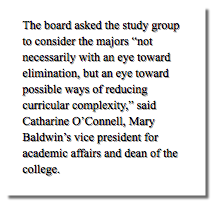
Interviews with top college officials and a number of professors (most of whom requested anonymity for fear of reprisal), as well as a review of more than a hundred pages of internal documents obtained by Inside Higher Ed, reveal an institution in transition -- and in conflict. At Mary Baldwin, the administration’s focus on enrollment growth through new programs has left some faculty members convinced that the liberal arts college no longer has liberal arts at its center.

College officials maintain the institution has not strayed from its liberal arts mission. What’s occurring at Mary Baldwin, they say, is a philosophical dispute. A handful of professors are clinging to a conception of the liberal arts grounded in discrete disciplines -- an idea college officials say is outdated.

“We’re at a time in education when we’re moving beyond the disciplines that were created 100 years ago,” said Sarah Flanagan, chair of the academic affairs committee on Mary Baldwin’s Board of Trustees and vice president for government relations and policy at the National Association of Independent Colleges and Universities.

In recent years, many higher education experts have deemed many liberal arts colleges and women’s colleges -- at least those without billion-dollar endowments -- financially challenged, if not endangered.

Read the rest at Inside Higher Ed

Monday, April 21, 2014

Proposal: Two Years of Free College for All


A recent paper by Sara Goldrick-Rab and Nancy Kendall suggests the actual policy goals of federal financial aid might be better met by redirecting it away from private institutions and toward support of two years of free education at state institutions. 

The authors argue (among other things) that private institutions are subsidized but actively resist accountability measures to which public institutions are subject and even with current subsidies the privates enroll a very small portion of low resource students (be sure to read pp 24ff). 

It is a provocative plan by smart scholars of higher education; ideas like this should engage us both for their social justice implications and for their implications to our institutions' financial models.

Executive Summary

For almost fifty years, the federal government has tried to make the American Dream universally accessible by using need-based financial aid to lower the price of attending college. The effectiveness of this approach to expanding opportunity and investing in America’s future has diminished because of declines in real family income, increases in demand for college enrollment, poor regulation of state funding and institutional costs, insufficient funding for and targeting of grant aid, and a political movement that places the needs of private businesses and banks over those of students and families. The results have undermined the national ideal of equal opportunity to succeed and equal rewards for hard work. Talented students are forgoing college because of the costs, students who start college are unable to complete because they cannot afford to continue, and even students who finish degrees may not realize all of the expected returns because of sizable debt burdens. All but the wealthiest families must borrow or pay an amount equal to or exceeding one-quarter of their annual income in order to finance attending a public 4-year college or university.

Fortunately, financial aid is not the only way to make college affordable. We argue that it is time for the federal government to partner with states, public colleges and universities, and localities and businesses to offer two years of college for free. This paper outlines a Free Two Year College Option (F2CO) that can be funded with existing resources, developed to overcome the problems in previous efforts to make college more affordable, and designed to ensure that wider access occurs without reductions in educational quality. The effort begins with a simple message to every American interested in pursuing education after high school: If you complete a high school degree, you can obtain a 13th and 14th year of education for free in exchange for a modest amount of work while attending school. Key aspects of the F2CO plan include:
  • All eligible students can attend any public college or university (2-year or 4-year) for free for the first two years
  • Through a redirection of current federal financial aid funding, the federal government pays tuition for all students, and provides additional performance-based top-up funding for institutions that serve low-income students. We estimate that per-student funding will be higher than the average tuition currently charged by community colleges, and only slightly lower than the average tuition charged by four-year colleges
  • Participating institutions cannot charge tuition or additional fees to students
  • State funding for higher education will be redirected to cover books and supplies for all students
  • Student living expenses will be covered through a state and local stipend equal to fifteen hours a week of living wage employment in the area, federal work-study in an amount equal to fifteen hours a week of living wage employment in the area, and access to federal loans equaling up to five hours a week of living wage employment in the area
We believe that such a policy is long overdue, and will significantly expand the quality, efficiency, and effectiveness of our collective investments in postsecondary education and in a shared and secure future.

Friday, March 28, 2014

Switch Fonts, Save Ink (and dollars)

In the news over the last few days, reports about a kid whose science fair project was to compute how much the government could save by changing fonts. Long story short: some type faces require considerably less ink than others; the federal government prints lots and lots of documents; it buys a lot of ink and toner for its printers; it could buy less if it changed fonts.

Garamond, a typeface that requires about 25% less than other common fonts (such as Times New Roman), was  created by Claude Garamont in the early 16th century. How much could a school like our save? Not millions, a fair guess might be 10-20% of toner/ink costs.

See Also

Monday, March 24, 2014

For Some Colleges Financial Challenges Continue

This article from current Chronicle of Higher Education describes
a number of small colleges that continue to teeter on the edge even after the wider economic recovery.


Some factors that seem common in these stories are small size, niche focus (e.g., geographic or religious), recent lavish expenditures on attractive new facilities,(especially non-academic ones), and poorly timed optimism around fundraising.
Responses including layoffs, cutting under-enrolled programs, selling non-core real estate, drastic tuition cuts, expanding online offerings, adding professional programs


Monday, February 10, 2014

Who's a Cost Center? : The Higher Ed Work Force Report

The Delta Cost Project, a research group under the American Institutes for Research (AIR) that looks at higher education costs, has released a report titled "Labor Intensive or Labor Expensive? Changing Staffing and Compensation Patterns in Higher Education.

Unfortunately some of the analysis in the report is easy to misinterpret because it moves back and forth between headcount, FTE, and dollars. Sometimes a trend toward more part time employees looks like growth in workforce, sometimes not. Thus, their figure 1 (here truncated) might indicate growth in workforce at private master's and bachelor's institutions or it might reflect a shift from full time to part time employees.


Still, I think the report deserves a close reading and that the appropriate folks at my own institution should inquire about where we stand on each of the metrics described and then initiate some critical conversations on whether we are pleased or not by the answers.

But in any case, this quote : "You can’t blame faculty salaries for the rise in tuition. Faculty salaries were 'essentially flat' from 2000 to 2012, the report says" from the CoHE article below will probably engender some interesting conversations.


See Also


Props to Maia Averett for calling HuffPost to my attention.