Showing posts with label women's colleges. Show all posts

Wednesday, December 9, 2015

And then there were ...

From Inside Higher Ed
College of New Rochelle Goes Completely Coed
December 9, 2015
Another women's college has decided to go completely coeducational.
The College of New Rochelle on Tuesday announced its plans to begin accepting men into its School of Arts & Sciences in fall 2016. The New York college has been accepting men in other programs for about four decades. Its School of Nursing, School of New Resources (for adult learners) and Graduate School are already coed -- the college's School of Arts & Sciences was the last holdout, and has been women only since the college was founded in 1904.
“This decision was made after very careful thought, evaluation of several key factors, and above all with a great reverence for the college’s mission,” Elizabeth LeVaca, chair of the college's governing board, said in a statement, adding that the board received supportive feedback on the change.
Facebook page for New Rochelle alumni contained a mix of comments, many supportive and understanding but several quite critical.

Wednesday, July 23, 2014

Stop Me If You've Heard This One

From Inside Higher Ed

What's Expendable?

July 21, 2014
By Charlie Tyson

In March 2013, when the Faculty Senate at Mary Baldwin College met with the college’s president, tensions were running high. Professors at the private women’s college in Staunton, Va. had not received raises in six years. And a mandate from the Board of Trustees instructing faculty to examine low-enrollment majors had ignited rumors. Professors worried the college would cut certain liberal arts programs: French, Spanish, chemistry and other majors that attracted few students. Surrounded by her colleagues, Ivy ArbulĂș, an associate professor of Spanish, spoke.
“There are no ‘expendable’ majors, and most certainly not if what is expendable and what is not is decided by the popularity of majors amongst our students,” she said. “All majors are part of the education we offer.”
The Spanish professor, known at Mary Baldwin for her rigorous standards and dedication to students, died of leukemia six weeks later. She left behind a Spanish department with just one faculty member. In September, an interdisciplinary major in Latin American Literatures and Cultures will replace the traditional Spanish major ArbulĂș championed. The French major, too, has been cut, and a number of upper-level course offerings in liberal arts are being phased out.
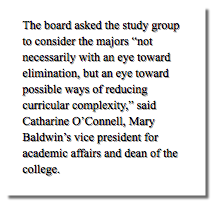
Interviews with top college officials and a number of professors (most of whom requested anonymity for fear of reprisal), as well as a review of more than a hundred pages of internal documents obtained by Inside Higher Ed, reveal an institution in transition -- and in conflict. At Mary Baldwin, the administration’s focus on enrollment growth through new programs has left some faculty members convinced that the liberal arts college no longer has liberal arts at its center.

College officials maintain the institution has not strayed from its liberal arts mission. What’s occurring at Mary Baldwin, they say, is a philosophical dispute. A handful of professors are clinging to a conception of the liberal arts grounded in discrete disciplines -- an idea college officials say is outdated.

“We’re at a time in education when we’re moving beyond the disciplines that were created 100 years ago,” said Sarah Flanagan, chair of the academic affairs committee on Mary Baldwin’s Board of Trustees and vice president for government relations and policy at the National Association of Independent Colleges and Universities.

In recent years, many higher education experts have deemed many liberal arts colleges and women’s colleges -- at least those without billion-dollar endowments -- financially challenged, if not endangered.

Read the rest at Inside Higher Ed

Thursday, April 24, 2014

The "Seven Sisters" Class of 1968

The New York Times is "celebrating" its digitization of its 1964 issues with the occasional article from "50 years ago this week." This piece from when admissions to selective east coast women's colleges was a news item.  Note that acceptance rates at half the schools have gone down but half remain at about the same levels they were 50 years ago.


Tuesday, December 31, 2013

(One of) The Most Interesting College(s) in America

What if Mills were organized into "five undergraduate schools... : School of Fine Arts, School of Natural Science, School of Social Institutions, School of Education and School of Language and Literature"?

What if it branded itself "one of America's most interesting colleges"?

What if our general education program was simply to require that students "take at least half of her work outside the particular school in which she is majoring"?

What if we minimized the importance of marks and credits and instead required that "to earn a degree, a student must cover a definite educational area and must be able to demonstrate her complete understanding of the territory covered"?

What if we offered courses in Chinese language and literature?

What if we offered courses in which 5 or 7 professors (or maybe even ALL the professors in a division) collaborated to present material and in which large fractions of the student body enrolled?

What if we took advantage of our small size and instituted a "tutorial plan, adapted from the English
university system" in which "each entering student is assigned a tutor who, as 'guide, philosopher and friend,' takes a warm and continued interest in her progress"?  And may highly prepared and talented students could be "encouraged to set their own academic pace" while less prepared are coached on "how to make their efforts more effective" and reach the highest levels of achievement?

If it sounds new and exciting, be prepared for a let down.  This was Mills in 1935.