Thursday, November 20, 2014

Journalism as 'Gateway Degree'

FROM the PBS MediaShift Blog

This essay is about journalism education but its conceptualization of journalism education as a gateway degree along with the how and the why of implementing that vision makes it a useful read for those of us in liberal arts regardless of our relationship to journalism.  

The author notes along the way that we already know that (1) journalism is known to be good prep for professional schools, and that (2) most journalism and communications majors do not become practicing journalists.  These should sound familiar to those of us who teach in SLACs, mutatis mutandis.

Schaffer's prescriptive response is for j-schools to think through what else they are good for: identify the constellations of skills that can be included in the j-school education and identify where they can take a graduate (hints of "you need to be a bit more concrete than just lauding 'critical thinking'").

She suggests incorporating into the curriculum the capacity to scan the environment for opportunity (what Christensen calls “jobs [that need] to be done,” to develop a business plan, to build prototypes, to test audiences, and to assess markets.  This is a good business proposition not just because students might get jobs but because there is an entire ecosystem of small businesses, startups, and non-profits that need people like the ones we are training but we need to outfit them with the skill sets that will get them hired and make them capable of turning their ideas into going concerns that can actually make a difference.

Today's students, she argues, want to do more than "speak truth to power" or offer a blistering critique of the status quo.  Like Marx, perhaps, they realize that the point is to be effective and actually change the world by solving problems.


Education


Reimagining Journalism School as a ‘Gateway Degree’ to Anything

J-Lab director Jan Schaffer is wrapping up 20 years of raising money to give it away to fund news startups, innovations and pilot projects. She is pivoting J-Lab to do discrete projects and custom training and advising that build on her expertise. After two decades of work at the forefront of journalism innovations, interactive journalism and news startups, she weighs in with some observations and lessons learned. This post addresses journalism education and first appeared here.
If I were to lead a journalism school today, I’d want its mission to be: We make the media we need for the world we want.
Not: We are an assembly line for journalism wannabes.
The media we need could encompass investigative journalism, restorative narratives, soft-advocacy journalism, knowledge-based journalism, artisanal journalism, solutions journalism,civic journalism, entrepreneurial journalism, explanatory journalism, and maybe a little activist journalism to boot. That’s in addition to the what-happened-today and accountability journalism.
Journalism is changing all around us. It’s no longer the one-size-fits-all conventions and rules I grew up with. Not what I was taught at Northwestern’s Medill School of Journalism. Not what I practiced for 20 years at The Philadelphia Inquirer.
Yet, as someone who consumes a lot of media, I find I like journalism that has some transparent civic impulses, some sensibilities about possible solutions, and some acknowledged aspirations toward the public good. Even though I realize that might make some traditional journalists squirm.
And I’d assert that — if the journalism industry really wants to engage its audiences and woo new ones, and if the academy wants its journalism schools to flourish — it’s time for journalism schools to embrace a larger mission and to construct a different narrative about the merits of a journalism education.
There is some urgency here. Colleges and universities are cascading toward the disruptive chaos that has upended legacy news outlets. Many, like newspapers, will likely shut their doors in the next decade or two, victims of skyrocketing tuitions, unimaginative responses and questionable usefulness.
Adding to this imperative are indications that some J-School enrollments have declined in the last few years, according to the University of Georgia’s latest enrollment survey released in July. Industry retrenchment is partly blamed for making prospective students and their parents nervous about future jobs.

REMARKETING THE DEGREE

How do you quell that nervousness? One way is to articulate a new value proposition for journalism education; next, of course, is to implement it.
It’s time to think about trumpeting a journalism degree as the ultimate Gateway Degree, one that can get you a job just about anywhere, except perhaps the International Space Station.
Sure, you might land at your local news outlet. But, armed with a journalism degree, infused with liberal arts courses and overlaid with digital media skills, you are also attractive to information startups, non-profits, the diplomatic corps, commercial enterprises, the political arena and tech giants seeking to build out journalism portfolios, among others.
We already know that a journalism education — leavened with liberal arts courses and sharpened with interviewing, research, writing, digital production and social media competencies — is an excellent gateway to law school or an MBA. And we already know that journalism education has moved away from primarily teaching students how to be journalists. Indeed, seven out of 10 journalism and mass communication students are studying advertising and public relations, according to the UGA study.

Tuesday, September 30, 2014

Why are fewer people going to college?

BY SIMONE PATHE  September 29, 2014 at 11:41 AM EDT
"The drop-off in college attendance between 2012 and 2013 was across all income levels, although it was sharpest among the Census Bureau’s middle-income range — families making between $20,000 and $75,000. 
"That fewer of those families are sending kids to college is bad news for colleges, Carnevale said, because it strikes at the heart of their business model, although it’s less of a threat to selective institutions, which already have long lines to entry and intentionally keep their enrollments small."
In today’s economy, earning a college degree is still a winning choice. The  unemployment rate for Americans with bachelor’s degrees or higher is just 3.2 percent, compared to a national average of 6.1 percent. So why, then, did college enrollment last year fall by nearly half a million?

Between 2012 and 2013, the Census Bureau reported last week, 463,000 fewer people were enrolled in college. In fact, this is the second year enrollment has fallen by that much, bringing the two-year total to 930,000 fewer college students, bigger than any drop before the recession. The Census Bureau has been collecting this data through the Current Population Survey since 1966.

The decline was to be expected, said Anthony Carnevale, director of Georgetown’s Center on Education and the Workforce, repeating the old economics adage that the more things go up, the more they’ll eventually fall. And go up it certainly had. The recent decline comes on the heels of a record 3.2 million boom in college enrollment between 2006 and 2011.

So where is the current decline happening, and what can that tell us about why it’s happening? Not all colleges are the same, and not all students have equal access to higher education. Enrollment in two-year colleges decreased by 10 percent, while enrollment in four-year schools actually increased, albeit by only 1 percent.

Hispanic college enrollment had been increasing dramatically in the five years up to 2012, adding a million students, far more than blacks or Asians added to the collegiate ranks. But that growth ground to a halt between 2012 and 2013. Hispanics, the Census Bureau points out, are more likely than blacks, whites or Asians to attend two-year schools, reflecting the drop seen in this latest data.

College enrollment always follows the economic cycle, said Carnevale. When the economy is underperforming, the college campus is a “safe harbor.” As he put it, going to school beats living in the basement and dealing with your parents when you cannot find a job. But when the economy improves, and jobs are more available, fewer people flock to the ivory tower. That pattern tells a cyclical story about college enrollment.

There’s a structural story here, too, though. It’s hard to ignore, over the long-term, how much more widespread college-going has become. The 1960s and 1970s forever changed college enrollment in America, Carnevale said; the Vietnam War and the draft gave new meaning to the college campus as “safe harbor.” Many more jobs now require a college education, and despite the increasing supply of college grads, the college wage premium (the earnings advantage to having a college degree) remains extraordinarily high, according to Carnevale.

Wednesday, August 27, 2014

A Salary Plan for All that Addresses Income Inequality

Colleges Could Narrow the Income Gap on Campuses

Growing inequality threatens our society.
A few years ago, such a provocative claim might have had limited support beyond a public park in lower Manhattan. Today a rising tide of voices warns of the ill effects of the increasing concentration of wealth and income. The warnings come from academics like Thomas Piketty, politicians like Sen. Elizabeth A. Warren, a Democrat from Massachusetts, and, at times, President Obama. Now even the self-described "zillionaire" Nick Hanauer, in a recent Politico article, implores us to avoid what he characterizes as an impending rush of pitchforks.
...
At St. Mary’s College of Maryland, a public honors college, a group of faculty and staff members, students, and alumni have put together a proposal that would permanently cap the growing ratio between the top and bottom earners on the campus. The St. Mary’s Wages plan would establish a benchmark minimum salary for the lowest-paid full-time employees that would rise with inflation. Tenure-track faculty members would make at least twice that benchmark. Different groups of workers (for example, associate professors, professional-staff members) would be guaranteed wages above specified fixed multiples of the lowest salary.

Wednesday, July 23, 2014

Stop Me If You've Heard This One

From Inside Higher Ed

What's Expendable?

July 21, 2014
By Charlie Tyson

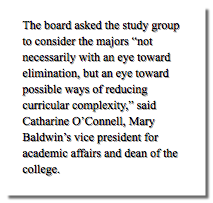
In March 2013, when the Faculty Senate at Mary Baldwin College met with the college’s president, tensions were running high. Professors at the private women’s college in Staunton, Va. had not received raises in six years. And a mandate from the Board of Trustees instructing faculty to examine low-enrollment majors had ignited rumors. Professors worried the college would cut certain liberal arts programs: French, Spanish, chemistry and other majors that attracted few students. Surrounded by her colleagues, Ivy ArbulĂș, an associate professor of Spanish, spoke.
“There are no ‘expendable’ majors, and most certainly not if what is expendable and what is not is decided by the popularity of majors amongst our students,” she said. “All majors are part of the education we offer.”
The Spanish professor, known at Mary Baldwin for her rigorous standards and dedication to students, died of leukemia six weeks later. She left behind a Spanish department with just one faculty member. In September, an interdisciplinary major in Latin American Literatures and Cultures will replace the traditional Spanish major ArbulĂș championed. The French major, too, has been cut, and a number of upper-level course offerings in liberal arts are being phased out.

Interviews with top college officials and a number of professors (most of whom requested anonymity for fear of reprisal), as well as a review of more than a hundred pages of internal documents obtained by Inside Higher Ed, reveal an institution in transition -- and in conflict. At Mary Baldwin, the administration’s focus on enrollment growth through new programs has left some faculty members convinced that the liberal arts college no longer has liberal arts at its center.

College officials maintain the institution has not strayed from its liberal arts mission. What’s occurring at Mary Baldwin, they say, is a philosophical dispute. A handful of professors are clinging to a conception of the liberal arts grounded in discrete disciplines -- an idea college officials say is outdated.

“We’re at a time in education when we’re moving beyond the disciplines that were created 100 years ago,” said Sarah Flanagan, chair of the academic affairs committee on Mary Baldwin’s Board of Trustees and vice president for government relations and policy at the National Association of Independent Colleges and Universities.

In recent years, many higher education experts have deemed many liberal arts colleges and women’s colleges -- at least those without billion-dollar endowments -- financially challenged, if not endangered.

Read the rest at Inside Higher Ed

Monday, July 21, 2014

From the Stanford Report, July 21, 2014

Inspiring Stanford humanities majors to consider business careers

This summer was the first time that Stanford provided funding – with support from the Office of the President – to help Stanford students majoring in the humanities and the arts take part in the Summer Institute for General Management at the Graduate School of Business.

BY KATHLEEN J. SULLIVAN

On a recent summer morning, a lecture hall at Stanford Graduate School of Business (GSB) was filled with students from around the world who were ready to analyze the fall – and subsequent resurrection – of an American kidney dialysis company.

To prepare for the lecture, titled "A Deep Dive into Company Culture," the students had read a GSB case study that described a company, Total Renal Care, which was once plagued by financial, operational, regulatory and morale problems.

Sarah Soule, the Morgridge Professor of Organizational Behavior at the GSB, stood facing the class of dozens of students majoring in the humanities, engineering sciences, economics and finance, law, social sciences, and natural and life sciences.

It was the third week of the Summer Institute for General Management (SIGM), a month-long program designed for exceptional college students – rising juniors and seniors –majoring in non-business fields and recent graduates with non-business degrees. The program is now in its 11th year.

"Let's begin in 1999, when Total Renal Care was a very troubled kidney dialysis company," said Soule, one of a dozen MBA faculty members who taught the SIGM students.

"What were the problems with the company?" she asked.

Sitting in the third row, Stanford junior Natasha Mmonatau, a history major concentrating in 20th-century African history, offered the first observation.

"They had acquired a lot of companies, similar dialysis centers, and they had trouble integrating them into their existing model," said Mmonatau, one of eight undergraduate humanities and arts majors at Stanford who received university funding to take part in this summer's program.

Read more at Stanford News

Friday, July 18, 2014

Pipeline? Teaching Style? Course Content? Career Climate?

WOMEN IN TECH

Some Universities Crack Code in Drawing Women to Computer Science
JULY 17, 2014
Claire Cain Miller

One of the reasons so few women work in tech is that few choose to study computer science or engineering. Only 18 percent of computer science graduates in the United States are women, down from 37 percent in 1985.

At a few top college programs, though, that appears to be changing.

At Carnegie Mellon University, 40 percent of incoming freshmen to the School of Computer Science are women, the largest group ever. At the University of Washington, another technology powerhouse, women earned 30 percent of computer science degrees this year. At Harvey Mudd College, 40 percent of computer science majors are women, and this year, women represented more than half of the engineering graduates for the first time.

These examples provide a road map for how colleges can help produce a more diverse group of computer science graduates. They also help answer a controversial question: Does the substance of computer science instruction need to be adjusted to attract women, or does recruitment and mentorship? It’s an important question because tech companies have so many jobs to fill, and because computer science skills have become necessary in almost every other industry, too.